Head-to-head comparison
The Castles of Burgundy vs Viticulture Essential Edition
Both are medium-weight euros around $50 to $60. Castles is the tighter head-down puzzle; Viticulture is the friendlier, more thematic game. Couples, Castles. Groups of four or more, Viticulture.
 medium weight
The Castles of Burgundy
medium weight
The Castles of Burgundy
$52.98
Acquire and manage estates in Medieval France to accumulate wealth.
Buy The Castles of Burgundy · $52.98 →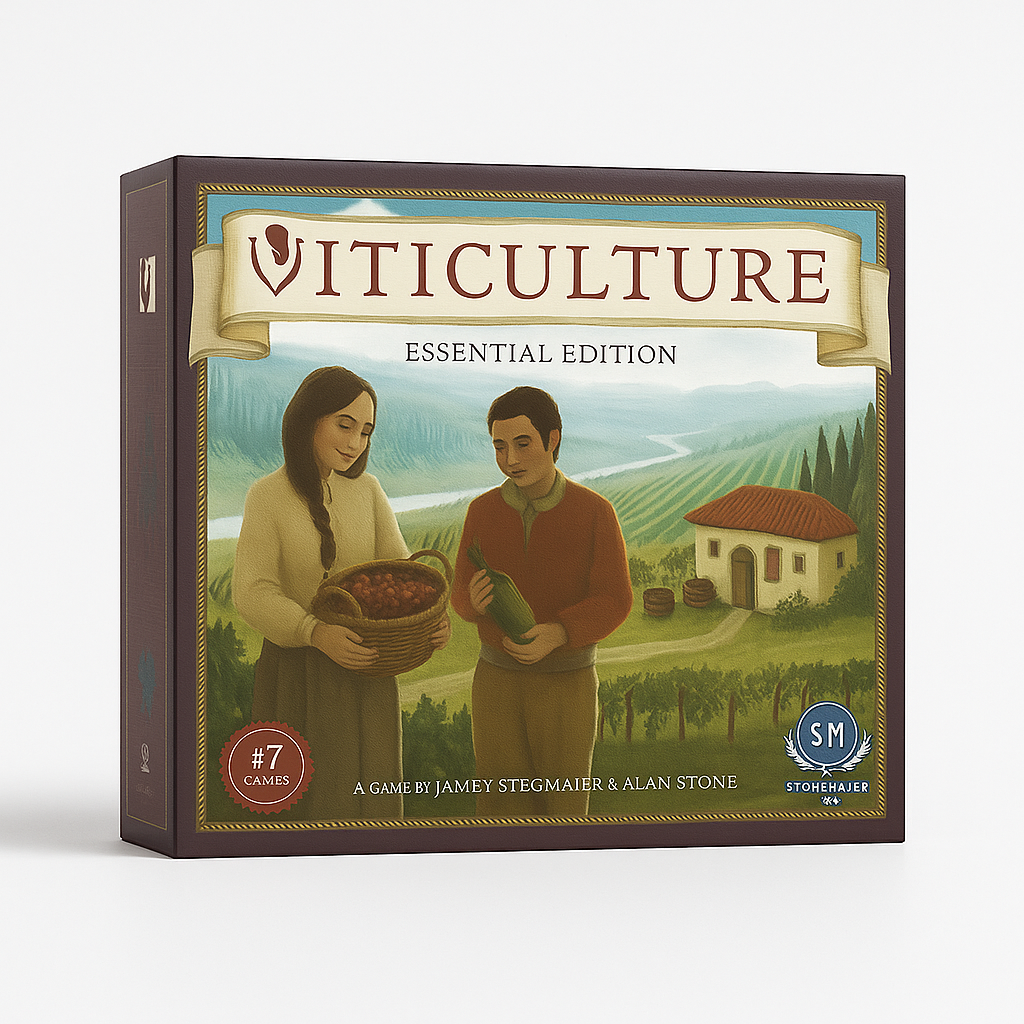 medium weight
Viticulture Essential Edition
medium weight
Viticulture Essential Edition
$52
Run your own vineyard by planting vines and harvesting grapes.
Buy Viticulture Essential Edition · $52 →Pick The Castles of Burgundy if
You want a low-interaction point puzzle with dice that offer choices rather than luck, playable in an hour at two players.
Pick Viticulture Essential Edition if
You want worker placement with a warm theme, seasons, visitor cards, and a bit more interaction over contested spots; it also plays up to six.
The tradeoff.
The Castles of Burgundy
The Castles of Burgundy tasks players with developing medieval estates across a shared map of France over six rounds. Each turn, you roll two dice and spend them to take actions: acquiring new hexagonal tiles from a shared pool, placing those tiles on your personal estate board, or shipping goods to increase your income. The tile placement itself is straightforward, but the dice rolls create genuine tension since your options are constrained by what the numbers allow. You're constantly balancing immediate needs against long-term planning, deciding whether to use a lucky roll for an urgent purchase or bank it strategically.
What separates Burgundy from other medium-weight euros is its elegant economic loop and the satisfying interplay between luck and mitigation. While dice rolls restrict your options, the game respects your agency by offering genuinely meaningful workarounds through shipping actions and careful estate building. The two-player experience is particularly excellent, where direct competition for tiles feels personal without descending into alpha-gaming. The game doesn't have the flashy appeal of newer titles, but it rewards repeated plays with emergent strategy that reveals itself gradually. Winning feels earned rather than lucky.
Viticulture Essential Edition
Viticulture Essential Edition puts you in charge of a budding vineyard across a series of seasons. Each turn, you'll take two actions from a small but meaningful menu: plant grape vines, build structures, harvest grapes, make wine, or fulfill orders for payment. The beauty lies in its elegant simplicity, there's no overwhelming decision tree, yet the order in which you execute these actions matters tremendously. You're gradually building toward completing wine orders worth victory points, and the first player to twenty points wins. The core loop feels natural and thematic without bogging down in unnecessary simulation.
What separates Viticulture from other medium-weight euros is its remarkable balance between accessibility and genuine strategic tension. Playing feels like running an actual business rather than shuffling tokens around a board. The asymmetrical player powers, drawn randomly at game start, create different viable paths to victory and ensure repeated plays feel fresh. There's real competition without nastiness, and while luck exists through card draws, skilled players consistently outperform lucky ones. The vineyard theme isn't pasted on; every mechanic reinforces the fantasy of building something.
These are editorial picks; publishers cannot pay to appear here. Amazon links fund the site, and if you'd rather buy local, find a store via BoardGameGeek.
Also worth considering.
Games that share contexts with both The Castles of Burgundy and Viticulture Essential Edition.

Strategically build and develop Mars faster than your opponents.…

Cooperative survival experience across unknown planets with deep exploration.…
Embark on cooperative fantasy adventures with app-assisted scenarios.…

Build industries and trading networks in an intense economic strategy.…