Head-to-head comparison
MicroMacro: Crime City vs Codenames
Micro Macro is cooperative map-searching; Codenames is competitive word cluing. Both work for 3-5 players.
 light weight
MicroMacro: Crime City
light weight
MicroMacro: Crime City
$30
Solve intricate mysteries by examining a giant city map full of clues.
Buy MicroMacro: Crime City · $30 → Light weight
Codenames
Light weight
Codenames
$20
Word-association party game. Plays with grandparents, college kids, anyone in between.
Buy Codenames · $20 →Pick MicroMacro: Crime City if
You want a cooperative deduction puzzle where everyone searches a giant map together, great for a group with no competition.
Pick Codenames if
You want competitive team word-guessing with a back-and-forth structure.
The tradeoff.
MicroMacro: Crime City
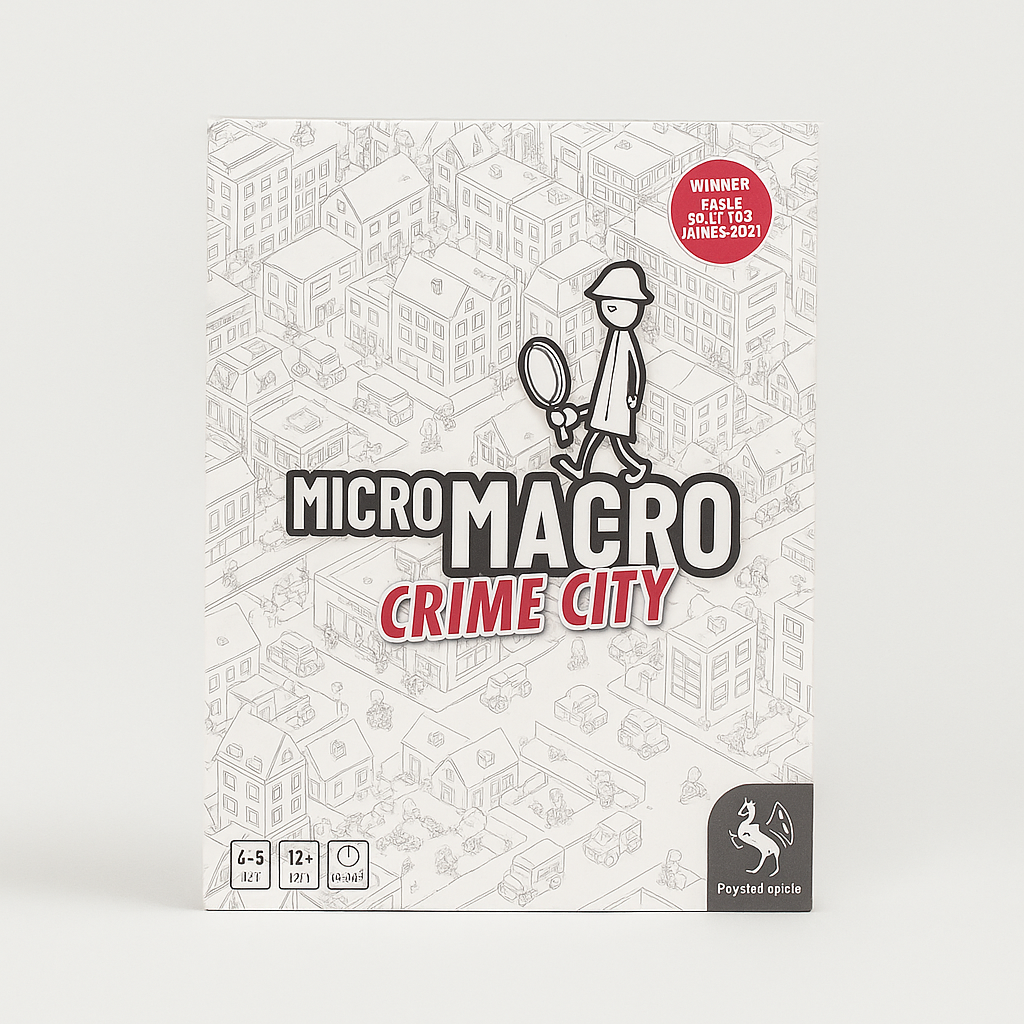
MicroMacro is a cooperative detective game where players collectively solve a series of interconnected mysteries by examining an enormous fold-out city map. One player reads a case description aloud while everyone else studies the sprawling illustrated landscape, searching for specific visual clues that answer questions about crimes, suspects, and their movements through the city. Rather than rolling dice or managing resources, you're simply looking and reasoning together, pointing to locations on the map and following chains of evidence until you've cracked the case. The entire experience unfolds through careful observation and group discussion, with solutions revealing themselves once you've found the right sequence of clues.
What distinguishes MicroMacro from lighter deduction games is the remarkable density and coherence of its beautiful illustration. The city feels genuinely alive with interconnected stories, you'll spot the same characters appearing in different locations, notice environmental details that matter, and experience genuine "aha" moments when disparate clues suddenly click into place. This creates a satisfying puzzle-solving experience that respects player intelligence without requiring specialized knowledge. Families and casual gamers will appreciate the accessible mystery structure, while more experienced players won't feel patronized. The collaborative nature means everyone wins or loses together, removing competitive tension and encouraging genuine teamwork.
Codenames
Codenames is a word-association game where two teams compete to identify their agents by interpreting one-word clues. One player per team acts as the spymaster, seeing a grid of twenty-five words and a hidden key card showing which words belong to their team. Spymasters take turns giving a single clue word plus a number, indicating how many of their team's words relate to that clue. Their teammates then point to words they think match, trying to identify all their agents before hitting an opponent's operative or the assassin, which ends the round immediately. The turn loop is simple, rapid-fire, and endlessly variable because the clue-giving drives everything.
What makes Codenames distinctive is how elegantly it transforms into a showcase for lateral thinking and shared references. The spymasters become improvisational comedians and lateral thinkers, searching for connections others might miss, while their teams become pattern-recognition detectives, debating interpretations in real time. There's genuine tension when a clue points to multiple possibilities and your teammate hesitates over which word to choose. The table fills with conversation, laughter, and occasional groans of "oh, I see it now." Unlike many light party games that feel more like charades variants, Codenames creates genuine moments of intellectual connection and creative problem-solving.
Best for: 5+ Players, Family with Kids, Holiday Gathering
These are editorial picks; publishers cannot pay to appear here. Amazon links fund the site, and if you'd rather buy local, find a store via BoardGameGeek.