Head-to-head comparison
Scythe vs Brass: Birmingham
Scythe is the accessible heavy game; Brass is the connoisseur's heavy game. Groups that want to feel clever every turn go Brass; groups that want a show on the table go Scythe.
 Heavy weight
Scythe
Heavy weight
Scythe
$90
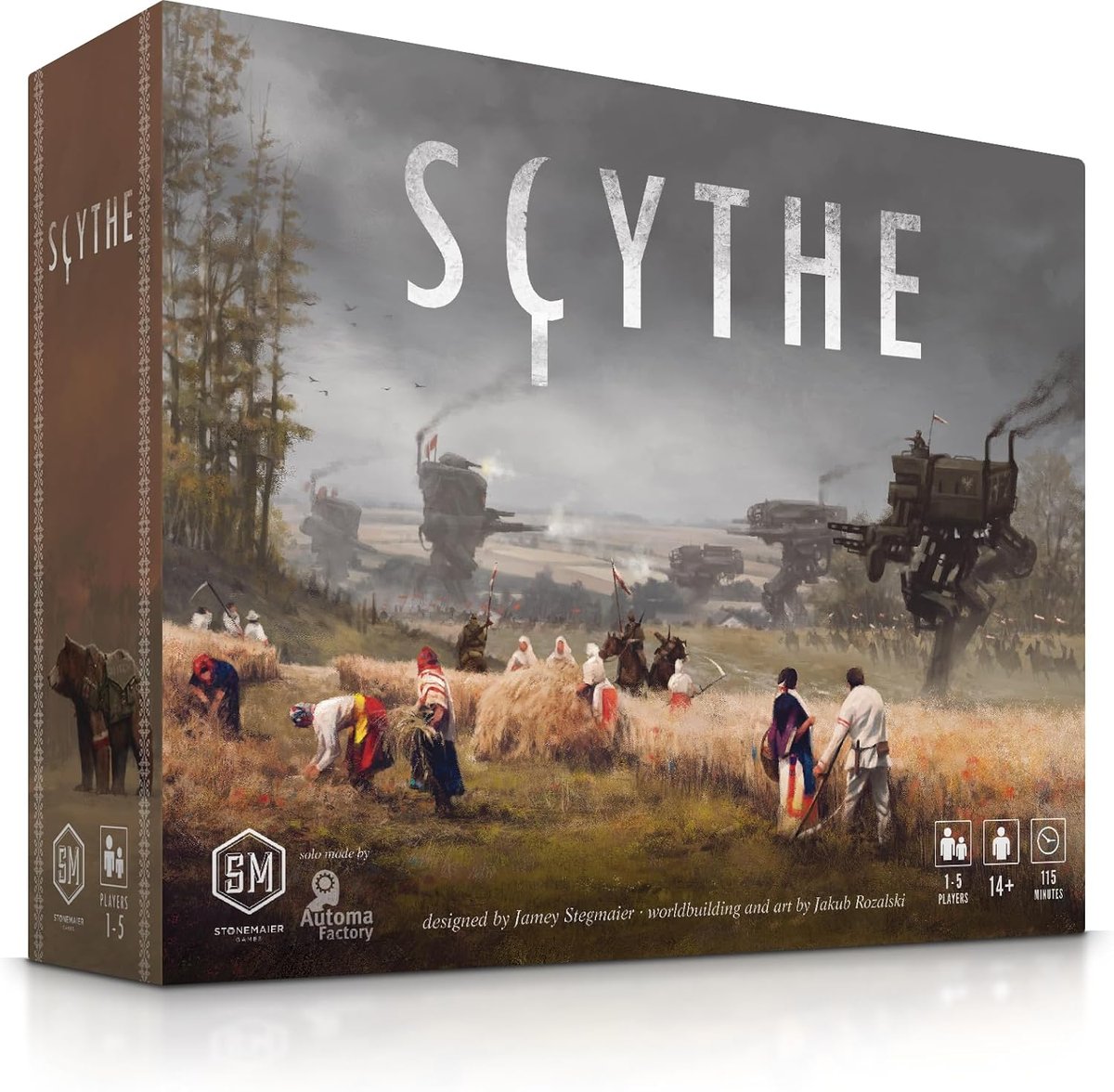
Mechs, farms, and quiet menace across an alternate 1920s Europe. An engine builder wearing a war game's armor.
Buy Scythe · $90 → heavy weight
Brass: Birmingham
heavy weight
Brass: Birmingham
$73.78
Build industries and trading networks in an intense economic strategy.
Buy Brass: Birmingham · $73.78 →Pick Scythe if
You want the visual spectacle and an easier on-ramp: Scythe teaches in twenty minutes and most of its depth is in engine timing rather than rules.
Pick Brass: Birmingham if
You want the tighter, purer economic puzzle with almost no luck, a two-era arc, and one of the most consistently top-rated designs of the last decade; the teach is heavier and the board is busier.
The tradeoff.
Scythe
Scythe is an engine building and area control game set in an alternate 1920s Europe of mechs and farmland. Each player gets an asymmetric faction and a separate player mat, and the combination defines your whole game. On your turn you move your action token to one of four sections of your mat and take its top action, such as moving units, producing resources, trading, or bolstering power, then optionally pay for the bottom action printed beneath it, like deploying a mech, building a structure, enlisting a recruit, or upgrading. You cannot pick the same section two turns in a row, so the game becomes a rhythm exercise: sequencing top actions so your bottom row engine fires as often as possible while upgrades steadily drop its costs. Stars mark achievements, the sixth star placed by anyone ends the game on the spot, and final scoring counts stars, territory, and resources, scaled by your popularity standing.
Understand what Scythe is before buying: the mechs and the brooding military art promise a war game, and it is not one. Combat exists, it is expensive, and most sessions contain only a handful of fights. This is a logistics and timing game wearing armor, closer in spirit to an efficiency focused euro than to a battle map brawl, and players who buy it for constant conflict routinely bounce off. Players who want to quietly assemble a terrifying economy, then end the game before the table realizes it is ending, adore it, which is why it has held a place near the top of the BoardGameGeek rankings for a decade.
Best for: Epic Evening, Solo, Strategy Night
Brass: Birmingham
Brass: Birmingham is a network-building economic strategy game where players develop industrial enterprises across 19th-century England. On your turn, you either play a card to build an industry, develop infrastructure, or sell goods for profit. Cards in your hand represent locations and resources, and playing them establishes factories, mines, and trading links. The clever twist: after playing a card, you discard your hand and draw new ones, forcing constant adaptation. The game spans two eras with different rules, and your network's value shifts dramatically between them. You're essentially constructing a supply chain while managing limited hand options and constantly shifting market conditions.
What separates Brass from other economic heavy-hitters is its elegant tension between long-term planning and forced improvisation. Every decision carries weight, building a steel mill creates future opportunities but locks you out of immediate pivots. The table experience feels genuinely tense; players watch each other develop competing networks with real stakes. The two-era structure means your carefully built empire undergoes seismic shifts halfway through, preventing anyone from running away with a dominant position. It's a game where clever timing and network positioning matter more than raw luck, rewarding players who can read opponents and anticipate disruptions.
These are editorial picks; publishers cannot pay to appear here. Amazon links fund the site, and if you'd rather buy local, find a store via BoardGameGeek.