Head-to-head comparison
Concordia vs The Castles of Burgundy
Both are modern classics of medium-weight euro design. Concordia is calmer and scales to five; Castle of Burgundy has dice and plays better at two. Pick by your usual player count.
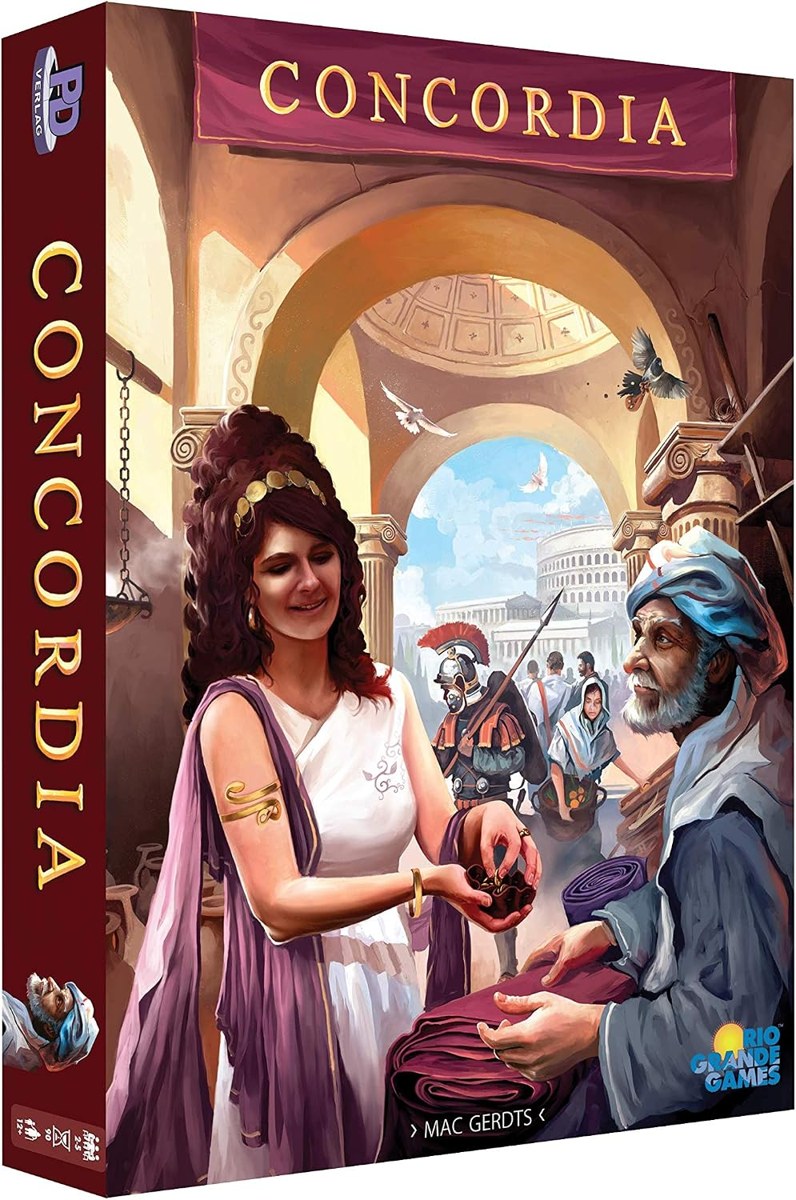 Medium weight
Concordia
$45.95, checked Nov 3. Was $45.92 before Oct 25.
Roman trade and settlement with a hand of action cards that become your score. Elegant, deep, no luck.
Buy Concordia · $45.95 → medium weight
The Castles of Burgundy
$52.98, checked Nov 3.
Acquire and manage estates in Medieval France to accumulate wealth.
Buy The Castles of Burgundy · $52.98 →Pick Concordia if
You want a card-driven trade game for up to five: play a card, act, and the cards you buy are also your scoring at the end.
Pick The Castles of Burgundy if
You want the dice-and-tile puzzle for two to four: each round you roll, and the dice decide which tiles you can place on your estate.
Side by side.
| Fact | Concordia | The Castles of Burgundy |
|---|---|---|
| Players | 2-5 | 2-4 |
| Playing time | 90 min | 30-90 min |
| Weight | Medium | Medium |
| Price today | $45.95 | $52.98 |
- Both play at two.
- Biggest table: Concordia seats five, The Castles of Burgundy stops at four.
- Cheaper today: Concordia by $7.03, prices checked Nov 3.
The tradeoff.
Concordia
Concordia is a game about spreading trade colonies across the Roman world, driven by one of the most elegant mechanisms in the hobby: your hand of action cards is also your scoring. Each turn you play one card, move colonists and build in cities, buy goods, produce in a province, or take a Senator to buy new cards. Every card names a god, and at the end of the game each god scores you points based on what you built: cities per province, colonists on the board, goods you can supply. So buying a card is both an action and a bet on how your empire will look at the end.
There are no dice, no randomness beyond the order the cards come out, and no direct attacks. The interaction is subtle and constant: cities cost more as they fill up, so being second into a region hurts, and the Prefect action that produces goods in a province produces for everyone with a house there, so your rivals piggyback on your economy. Reading the map and timing your expansions around other players is where the depth lives.
Best for: Strategy Night, Epic Evening, 3-4 Players
The Castles of Burgundy
The Castles of Burgundy tasks players with developing medieval estates across a shared map of France over six rounds. Each turn, you roll two dice and spend them to take actions: acquiring new hexagonal tiles from a shared pool, placing those tiles on your personal estate board, or shipping goods to increase your income. The tile placement itself is straightforward, but the dice rolls create genuine tension since your options are constrained by what the numbers allow. You're constantly balancing immediate needs against long-term planning, deciding whether to use a lucky roll for an urgent purchase or bank it strategically.
What separates Burgundy from other medium-weight euros is its elegant economic loop and the satisfying interplay between luck and mitigation. While dice rolls restrict your options, the game respects your agency by offering genuinely meaningful workarounds through shipping actions and careful estate building. The two-player experience is particularly excellent, where direct competition for tiles feels personal without descending into alpha-gaming. The game doesn't have the flashy appeal of newer titles, but it rewards repeated plays with emergent strategy that reveals itself gradually. Winning feels earned rather than lucky.
These are editorial picks; publishers cannot pay to appear here. Amazon links fund the site, and if you'd rather buy local, find a store via BoardGameGeek.